
Connected commerce describes how CPG brands and retailers align ecommerce, retail media, data, technology, and shopper engagement into a single operating model.
Rather than treating digital commerce, in-store activity, marketing, and analytics as separate functions, connected commerce focuses on how these elements work together to drive consistent growth across channels.
As consumer journeys become more fragmented, connected commerce has become less about channel expansion and more about organisational alignment.
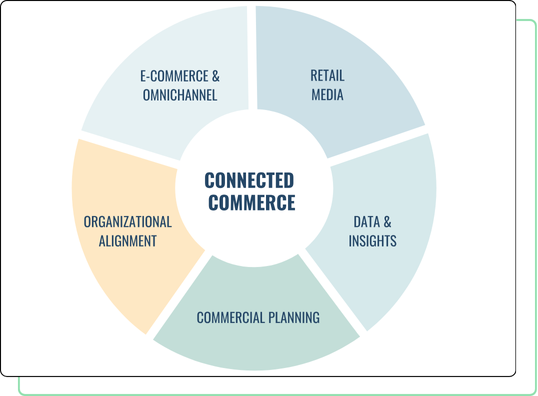
For CPG and retail organisations, growth no longer comes from optimising one channel in isolation.
Shoppers move fluidly between online research, retail media exposure, in-store purchase, and post-purchase engagement. At the same time, internal teams often remain structured around individual channels, platforms, or metrics.
This disconnect creates challenges such as:

Inconsistent shopper experiences across touchpoints
Limited visibility into total commercial performance
Difficulty measuring the impact of retail media on sales
Misalignment between ecommerce, marketing, and commercial teams
Connected commerce emerges as a response to these challenges, focusing on integration rather than expansion.
Connected commerce is not a single platform or technology. It is a way of working that brings together multiple disciplines.
In practice, connected commerce typically spans:

Ensuring product content, availability, pricing, and discoverability are aligned across retailers and channels.

Connecting media investment to commercial outcomes rather than treating it as a standalone marketing activity.

Using consistent data frameworks to understand performance across channels, retailers, and markets.

Aligning how brands engage shoppers before, during, and after purchase.

Supporting collaboration across teams rather than reinforcing silos.

Aligning joint business planning, retailer partnerships, and commercial priorities with ecommerce, retail media, and shopper strategies to ensure execution reflects shared growth objectives.
Traditional commerce models often separate responsibilities:
Ecommerce teams focus on online sales
Marketing teams focus on campaigns and media
Commercial teams focus on retailer relationships
Data teams focus on reporting and insights
Connected commerce shifts the focus from ownership to outcomes.
Instead of asking:
.svg)
“Which team owns this channel?”
Connected commerce asks:

“How does this activity contribute to total growth?”
This change in perspective affects how organisations plan, measure, and execute commerce strategies.
Connected commerce is most relevant for organisations operating in complex retail environments.
This includes:
CPG brands selling across multiple retailers and channels
Retailers managing both physical and digital touchpoints
Teams responsible for ecommerce, retail media, shopper marketing, data, and commercial strategy
Commercial planning and retailer collaboration
It is particularly relevant where:
Multiple teams influence the same shopper journey
Performance data is fragmented across platforms
Growth depends on coordination rather than scale alone
Retail media investment is growing faster than measurement maturity
In practice, connected commerce is not implemented all at once and Organisations typically progress through stages, such as:
Improving visibility across ecommerce and retail media performance
Aligning metrics and KPIs across teams
Strengthening collaboration between marketing, commerce, and data functions
Using insights to inform both media and commercial decisions
The maturity of connected commerce varies by organisation, market, and category.
The Connected Commerce Summit focuses on how these principles are applied in real CPG and retail environments.
Rather than treating connected commerce as a theoretical framework, the summit explores how teams are addressing practical challenges related to:
Ecommerce execution
Retail media strategy
Data and measurement
Organisational alignment
The summit series brings together practitioners to share experiences, approaches, and lessons learned across markets.
Connected commerce refers to how CPG brands and retailers align ecommerce, retail media, data, technology, and shopper engagement into a unified operating model.
Omnichannel focuses on operating across multiple channels. Connected commerce focuses on integration between teams, data, media, and execution across those channels.
Connected commerce is most relevant for CPG brands and retailers operating across multiple retailers, markets, and channels where coordination between teams influences commercial performance.
Not necessarily. Many organisations begin by improving alignment between existing tools, data sources, and teams before investing in new technology.
CPG brands operate in complex retail environments with fragmented data and multiple touchpoints. Connected commerce helps improve visibility, alignment, and consistency across the shopper journey.


